robotmonkeys

the monkeys know all

Search results for: “people”

  • Thomas Allen

    Categories: ,

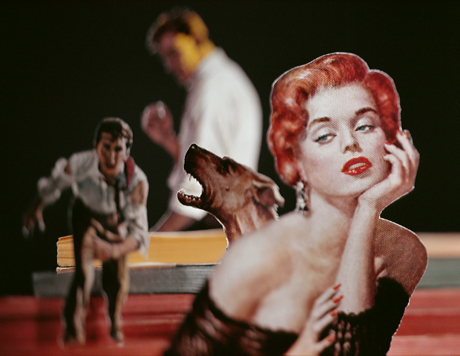
    When I attended the SF Fine Art Fair one the few artists that really stood out to me as Thomas Allen. His photographs, like “Epilogue” above, consist of cutouts from the covers of pulp novels arranged in such a way to tell a new story. Some of these photos are collected in his book, Thomas Allen: Uncovered.

    It’s second tier art, because the real visual oomph comes from simply the wholesale appropriation of the original artists’ works. It’s a collaged diorama, while executed with much more visual skill, it’s still reminiscent of the types of collages people would hack together from magazine cut outs, and turn in for extra credit in high school English I. Still, I do enjoy his work, even if I find its originality ironic.

    Previously.

  • Shared Artifacts

    Categories: ,

    Schuresko one time mentioned using shared artifacts for collaboration and social network interaction. Instead of simply just clicking buttons in lists, users would manipulate representations of the activities/messages more like how one drags icons around on a desktop. He mentioned OLPC’s Sugar interface, and how other OLPC users show up as icons on the home screen, complete with icons indicating what activity they are currently engaged in. Since many of the OLPC applications are collaborative, clicking on a user’s icon will crate a shared session with him/her. Also, when users are collaborating, their icons appear huddled around the same activity icon.

    I hadn’t seen anything like that interface before, especially deployed outside of a lab. I thought about that recently when trying to simply share a folder on my computer with Ming’s was an exercise in frustration. (Either we couldn’t log in to each other’s machines, or the network link would collapse immediately after beginning the transfer.)

    Later, I saw an ad for Microsoft’s Kin phone. It interface (shown above, you have to click around on their link unfriendly site to find the video yourself) seems pretty novel. The user is initially presented with a graphical life stream. From this, they can drag items down to the area immediately below the stream (the “Kin Spot”) to share them with people in their address book. Again, destinations are selected from a graphical stream and dragged to the spot. Tapping the spot allows the final message is edited and then sent.

    It would be interesting to create an interface like this for Diaspora, if that ever gets off the ground.

  • Users and Choice

    Categories: ,

    People will often want more information than they can actually process. Having more information makes people feel that they have more choices. Having more choices makes people feel in control. Feeling in control makes people feel they will survive better.

    — The Psychologist’s View of UX Design by Susan Weinschenk

    versus

    Autonomy and Freedom of choice are critical to our well being, and choice is critical to freedom and autonomy. Nonetheless, though modern Americans have more choice than any group of people ever has before, and thus, presumably, more freedom and autonomy, we don’t seem to be benefiting from it psychologically.

    — Barry Schwartz, “The Paradox of Choice: Why More Is Less”, 2004, Chapter 5

    via Unknown 8 Bit

  • The Lynching of Mario

    Categories: ,

    Mario, was a recent Italian immigrant, just trying make a living cleaning drains and fixing leaking pipes. No one paid much attention to him at first, but as the number of recent arrivals from Italy increased, tensions in the community grew.

    On that fateful Saturday, a rumor spread that Mario had been caught trying to force himself on one of the town’s beautiful blonde maidens, Peach. Gathering clubs, the townspeople gather outside the small cottage that Mario shared with is brother, and demanded Mario to be sent out. When they refused, they broke through the door, and beat Mario’s brother so hard that he remained in the hospital for a week and almost died.

    Mario was dragged from his home, and hanged in a near by tree. As hung there, slowly strangling, men and children would beat him until he died, and then continued to beat him until his body broken and torn.

    After the lynching, doubts about the rumor began. Some even say that the rumor was started by an rival plumber with a vendetta. The truth is now lost.

  • Pinball Coffee Table

    Categories: ,

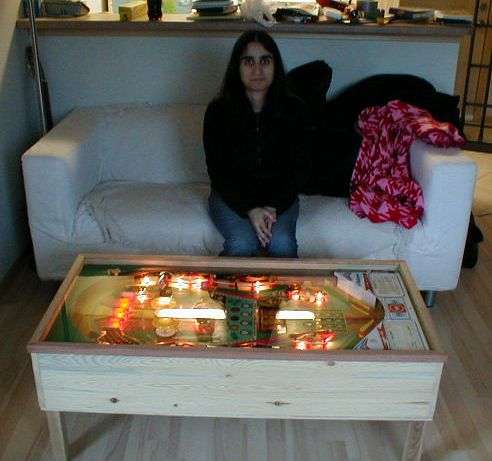
    When I first saw the Pinball coffee table back in 2006, I thought it looked cool (colored lights shining up on people’s faces always brings a warmth to the heart of this scifi geek.), but at the same time, I couldn’t imagine actually having one.

    A couple of years ago, I went to Shorty’s in Seattle. This bar has booths where the table has a lit pinball playfield in it, just like the pinball coffee table. (In fact, Shorty’s was the inspiration for the coffee table.) Suddenly, I thought that pinball coffee tables were actually feasible!

    I talked to some friends about it, but they’re all against the idea. As Ming put it, “It would look like a kid’s room.” It’s hard to really argue with her, when you see Ed Cheung’s table in the living room.

    I’m not criticizing the build, but I guess the idea. (Even though, I still kind of want one. Especially if it remained playable.) It’s a party piece, but not everyday piece. That’s what I’m saying.

  • Diaspora

    Categories:

    I ditched Facebook. I’ve grew tired of:

    1. RSS feeds not updating.
    2. Being frequently mysteriously logged out
    3. Having applications being added just for accidentally clicking on a damn Farmville-esque wall post.
    4. Being straight, and yet being served ads for gay dating sites.
    5. Applications getting all your information.
    6. Seemingly,. everyone getting your information.
    7. Being tracked.

    Facebook always gave me that shit tasted walled garden feeling of the late 90s. I hated how it how it seemed that more and and more techsavy people actually used it to send messages, rather than – you know – email. I like that status updates. I liked that sharing of links, but when I visted CNN.com after viewing Facebook, and seeing my friends’ activity on CNN, I flipped. There’s no reason why that information should be shared. I don’t think I got one of those damn pushed malware apps from Facebook, but I don’t know. Sure, I could have just configured some firewall to block a bunch of stuff, but voting with my feet is much more satisfying.

    Still, I like the social aspect. I am going to miss Mike and Lisa‘s comments. I really will. I like the sharing, but I want an archive of my activity. I want control. What should I do?

    Enter Diaspora.

    (more…)

  • Ukrainian Easter Eggs

    Categories: ,

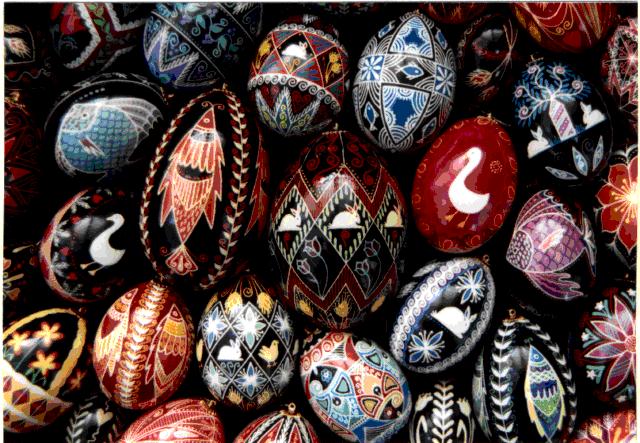
    Like many people, growing up, my family used to decorate Easter eggs, Only our eggs tended to be decorated like Ukrainian Easter eggs, or pysanky. My mom learned how to do this from a friend of hers, that truly an artist at it. Every year, we’d break out the beeswax candle, heat our styluses and attempt to draw deer or weave patterns, dots, or crosses on the eggs. Some years, we’d even bring out a hypodermic needle and a syringe and extract the yolks so we could keep the eggs for years.

    I decided that I wanted to decorate eggs this year, but all we had was the crayon and dye that’s in a Paas kit, and the new dye containing cotton swabs. (Using the swabs are pretty fun.)

    I pretty much resigned myself to not decorating eggs with candle wax for many many years, since I had no idea where to buy the stuff you need. Then for some unknown reason I checked out Make’s Top 10 Easter Themed Posts. In the list was a Ukrainian easter eggs. Following a couple of more links, I found out that that The Caning Shop in Berkeley sells everything. Hooray! Surprisingly, the book about how to make the designs my mom has had all my life is still in print.

  • SmartLEDs

    Categories: ,

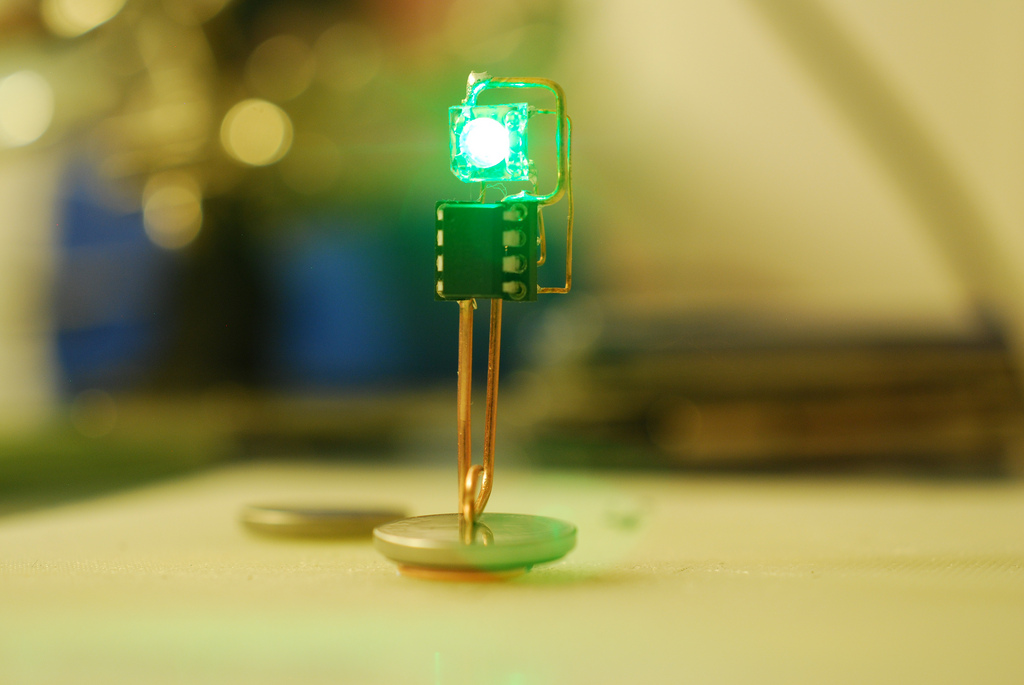
    Jim Blackhurst’s SmartLED SolarTherm is a minimalist information display. Consisting of an RGB LED, a watch, and an ATTiny25 microcontroller. The chip contains a temperature sensor whose reading is displayed as light pulses. According the comments on Makezine, the internal temperature sensor is +/- 10 C (+/- 18 F), so its not very useful.
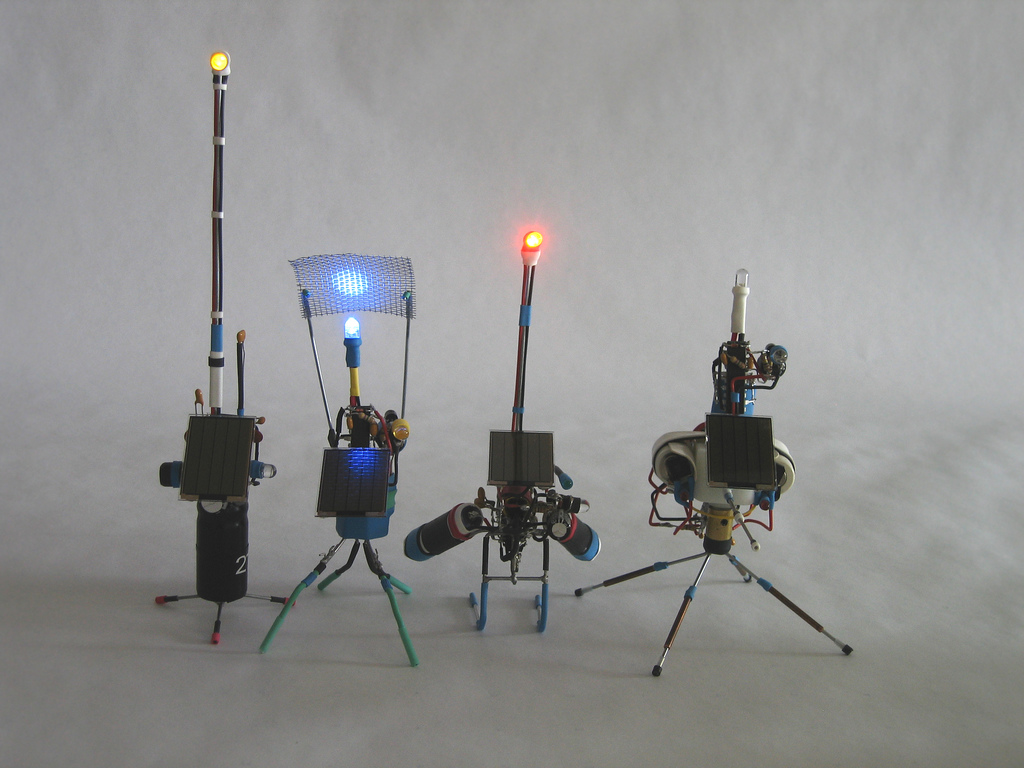
    SolarTherm is simpar to M27’s Zach DeBord’s pummers. These charge a capacitor from a solar cell, and when the light level drops, the capacitor discharges, and causes an LED to blink.

    While as an ambient displays these are visually interesting, especially Zach DeBord’s pummers, these seem to suffer from the main problem with all ambient displays. They trade simplicity for usefulness.

    I want the display to be both pretty, but also informative. The display needs to be immediately interrogated. Similar to the how a grandfather clock provides a chime ever 15 minutes to an hour, but also can be viewed in order to learn the exact time. I’m thinking of something like Riedi and Gloor’s Weather Diorama.

    Things like Nabaztag or the infinitely more endearing, Michael Kaminsky and Paul Dourish‘s SWEETPEA (aka “The Microsoft Barney Paper”) are more confusing than anything. Even baseball signs aren’t that confusing.

    Maybe the best ambient display I’ve seen was simply a string hanging from a DC small motor wired directly into an ethernet cable. As packets would pass, the motor would be powered, causing the string to wiggle. As the network activity increased, so would the vigorousness of the string’s dancing. The great thing about this display is that it’s immediately and intuitively interpretable, while something more complex requires the user to learn some of sign language.
  • Garden for a Not Too Distant Future

    Categories: , ,

    Spanish art collective, Luzinterruptus latest creation, Jardín para un Futuro, No Muy Lejano (Garden for a Not Too Distant Future), is 110 clear plastic containers, each containing a few leaves and branches, along with a green LED.

    The artist statement says that installation was a humorous statement about the lack of green space in modern cities; but given the frequency of their installations, I think that’s more just talk than anything.

    Luzinterruptus weekly installations are a bit repetitive. For instance, “Jardín” is reminiscent of their December work, Naturaleza Contra Cristal (Nature Against Glass), where they placed green LEDs and tree clippings on the Madrid Metro elevators stations. Parallels to Graffiti Research Lab‘s LED Throwies and Goggin and Keehn’s The Language of Birds could also be made.

    Yes, it’s repetitive. Yes, other people are doing the same thing, perhaps even better. But I’m a sucker for LEDs in the dark.

  • A Turing Machine

    Categories: ,

    Now this is inspired. Mike Davey has built an actual Turing Machine.

    A bit of background for non-CS people out there. A Turing Machine is a thought machine postulated by father of modern computing, and persecuted hero of World War II, Alan Turing. It was described as a machine that with a read-write head and infinite roll of tape that could pass back and forth under the head. Symbols could be read from the tape and then written back to the tape. What symbols, and where they were written would defined by rules that were triggered based on the symbols read from the tape.

    In modern parlance, this is a machine whose behavior is controlled not through hardwiring, but through software.

    Mike Davey isn’t the first person to build a Turing machine. (There’s at least one Lego Turing Machine.) But I do think he’s one of the few that built a machine that looks like a Turing Machine.

    Video after the jump.
    (more…)