robotmonkeys

the monkeys know all

Search results for: “people”

  • People for the Ethical Treatment of Robots

    Categories:

    In a Twitter inspired story, CNN asks, “is it cruel to kick a robot dog?”

    In what has become a become a regular demo by Boston Dynamics, engineers kicked the Spot the Robot Dog in order to push it off-balance and watch it stabilize itself. This time (and probably every time as well) number of people on Twitter said, “that poor robot!”, and so CNN rounded up the tweets and asked retired AI and robotics professor, Noel Sharkey about the ethics of kicking robots, who said, “The only way it’s unethical is if the robot could feel pain.” He then followed it up with the warning that because humans anthropomorphize things, we may become more likely to abuse things that can experience pain, because we’re used to it. He drew comparison to the philosophers who argued animals were “clockwork” (I’m not familiar with anyone using that term, but certainly the comment that animals are lesser than humans because they are soulless has been around for thousands of years), but none the less argued that animals should not be abused because it debased the abuser.

    His comment that it wasn’t unethical because animals did not feel pain, got me thinking. Yes this is certainly true, that the robot does not have any sensors to indicate damage with respect to these kicks, and it does nothing other than regain its balance, but the idea that “It’s cool, it doesn’t feel pain,” strikes me as just a variation of the old thinking machine conundrum. We say computers don’t think, because we completely understand the rules that govern its behavior. We say robots don’t feel pain, because they’re not alive. But it seems to me, that with pain, we have a simpler Chinese Room. I know that when I’ve run computer programs integrated computer programs that were suffering from some sort of system fault and logging errors continuously as “being in pain.” No the programs weren’t alive, but what is pain other than a signal indicating damage or negative reinforcement? Certainly error counters and exceptions do that. In a sense, that’s pain, or at least a reasonable functional facsimile there of.

    So is it wrong to kick Spot? I’m thinking it’s not, but at the same time, if you’re do it too much, and for enjoyment, maybe it is. Perhaps that’s not very satisfying, but isn’t it often the case, that the motivations of the actor the determining factor when deciding if something is moral or not?

  • San Francisco is a rotten heart

    Categories:

    San Francisco is the TechBro city, that maintains being the center of culture of the bay through inertia. The creativity is rotten, and what is good continues only because it hasn’t gotten the signal heart has stopped. It is the cells that continue to metabolize and conduct mitosis even after the heart has stopped.

    San Jose is what it’s been for 40 years. A bedroom community. Immigrants for tech firms and the support of people and white collar jobs. At its best, it’s granola culture suburbs.

    Oakland is rough and forgotten town. It’s where the conscious is. It’s genuine.

  • Asteroid Blues (2032)

    Categories:

    It’s 2032. Astronomers confirm that asteroid 2024 YR4 will impact the Earth unless a diversion plan launched immediately.

    (more…)
  • The Shocking and Forgotten Suicide of Don Knotts

    Categories: , ,


    On June 30, 1963, comedic actor Don Knotts shot himself in the head with a .38 caliber revolver during the live airing of The Ed Sullivan Show.

    Ironically, at the conclusion of the opening monologue, Sullivan remarked, “I’m really excited about tonight’s show. I think everyone is going to be talking about it around the water cooler in the morning.” At the time, everyone that heard the words simply thought it was just vapid self-promotion. Everyone that is, except for Knotts, listening to a feed of the show backstage in the green room.

    The show began normally. The first segment featured, a trained poodle act from Waukesha, Wisconsin that performed various flips, ball tricks, and riding tricycles while Stars and Stripes Forever played.

    Witnesses said they saw Knotts out of the dressing room, pacing around backstage chain smoking. When asked if something was wrong, Knotts just called it “anticipation”, saying he “just want[ed] to get on with it”.

    Knots was scheduled to reprise his Barney Fife character in a skit where Ed Sullivan gets stranded in Mayberry, followed by a brief interview.

    Coming back from commercial, the show opened with a whistling bars of the Andy Griffith show, and a facsimile of police station set from the show. Knotts in his Barney Fife costume sat with his feet up on a desk and his hat pulled down over his face. Stage left, a door opened and Ed Sullivan walked in. Sullivan delivered his first line, “Excuse me. My car has broken down, and I was wondering if you could help me.” Knotts simply stood up and walked over to Sullivan and muttered something that the microphones couldn’t catch.

    Sullivan looked a bit confused and repeated his line. Knotts looked disinterested, delivered some setup lines, allowing Sullivan to cue up the first big joke of the skit. Instead of delivering the punchline, Knotts said, “I’m not a clown.” Sullivan, visibly confused, repeated his line, and again, louder this time, Knotts said, ” I am not a clown.”

    Sullivan, now angry, demanded Knotts say the scripted line. Instead, Knotts drew the revolver he had as part of his costume. He unbuttoned his breast pocket and pulled out two bullets, and proceeded to load the revolver.

    Everyone in the theater was quiet. Sullivan eventually asked, “Are.. Are those real bullets, Don?”

    “Oh yeah. Bought them myself. They’re the real deal.”

    Sullivan put his arms out and tried to calm Knotts. Saying that no one was hurt, so everything would be fine, if he’d just put the gun down.

    Instead of calming the situation, Knotts became more agitated. “I am not a clown. Do you understand that? I AM NOT A CLOWN!”, Knotts shouted.

    The camera zoomed in on Knotts. He said he was tired of everyone thinking he was just a bumbling idiot. People on the street confusing his characters for him. Casting directors constantly casting him for the what is essentially the exact same role: The Clown. Tears welling up, he said he wanted to do drama. He wanted respect. “I did Shakespeare! Not Malvolio or Dogberry! I was King Lear! I was a good King Lear.”

    He collected himself, took a deep breath, and then simply said, “I am not a clown.” He quickly raised the gun to his temple. Off camera, a man shouted, “Don! No!” Knotts repeated, “I am not a clown,” and pulled the trigger.

    The crowd screamed, and camera spun and tilted. Quickly, the camera returned to Knotts’s body lying on the stage. Sullivan was standing next to him looking on in shock. Stagehands quickly gathered around Knotts’s body. After a few seconds, someone in a headset stepped in front of the camera while brandishing a clipboard in like a shield. As he moved towards the camera, he angrily shouted, “Turn the goddamn cameras off!”, before pushing the camera off from the image. The broadcast switched to a silent still title slide for the show. The smiling of caricature Ed Sullivan a gross mockery of the nightmare that has just unfolded live on national television.

    Across the Eastern a Central time zones, CBS affiliates struggled to fill the dead air. Some stations tried to find kinescopes of literally anything. Cleveland’s WOIO aired an episode of the Dick Van Dyke show. Boston’s WBZ ironically aired the Andy Griffith show. New York’s WCBS just ran the silent slide for the rest of the hour. By the time the show was scheduled for the Pacific and Mountain time, a previous episode of the Ed Sullivan show was prepared and aired.

    That night, CBS chief Hubbell Robinson ordered the kinescope of the episode destroyed. Without recordings, and general shifting of social tastes, Knotts and his suicide was forgotten.

    The episode was considered lost until 1996, when surviving kinescope film was found in an attic in Saugatuck, Michigan.

  • Just Be The Best You

    Categories:

    Scene: An airplane, with its engines engulfed in flames, is plummeting towards a hospital.

    New Hero: Shit. What do I do? There’re so many people that are going to die. What do I do? What do I do? Calm down. “Just think about saving one person,” that’s what he said right? Okay, I can do this.

    *whizz* *craaak* *wooft*

    Scene: The plane, with the fire now extinguished, sits carefully, but securely on the hospital’s roof. All the passengers and patients are safe.

    Reporter: Wow Hero! You really saved the day. Weren’t you scared?

    New Hero: I just imagined my mom was on the plane, and so I just knew I had to try.

    Reporter: Did you know that the plane was full of time travelers, including Baby Hitler?

    New Hero: Wait. What? What are you saying?

    Bystander: HEY! THIS ASSHOLE JUST SAVED BABY HITLER!

    Crowd: BOO! BOO!

    New Hero: I-i-it’s not like that! I… I just saved like a thousand people!

    Crowd: BOO! HITLER SAVER!

    Howard The Duck: I think you this milkshake is for you.

  • Suffering Robots

    Categories:

    Via Slate:

    According to Lance Gharavi, an associate professor of theater at Arizona State University, the question of free will rapidly resolves into a problem of desire. Steering the conversation into philosophical terrain, he observed that we can’t even say definitely whether humans have free will. But, he continued, if a robot has desires, even if those desires just involve the need to appropriately serve its master, then it can suffer. And if it can suffer, we have an ethical responsibility toward it. For Hartzog, on the other hand, the ethical stakes of human-like robots have more to do with the ways that we relate to humans.

    Previously.

  • When Charity Isn’t

    Categories: ,

    Quartz recently reported that “Millions of Facebook users have no idea they’re using the [I]nternet”. Specifically, in southeast Asia and Africa, there are more self-identified “Facebook users” than there are “Internet users.” Most of the Internet basically just said “Ha! Ha! Look at those stupid people!”, but that misses what’s really going — and explained in the Quartz article.

    In the developing world, most people don’t have computers, they have phones, and those phones aren’t even smartphones, they’re feature phones. When they browse Facebook, they aren’t using an app, or even m.facebook.com, they’re using what’s called “mbasic“. Additionally, the bandwidths are limited — say 2G — and the data rates are relatively expensive. In a very real sense, trying to surf the modern web is nigh-unusable. So Facebook experience is in certain sense not the Internet. The trouble comes in from the fact, that’s how Facebook wants it.

    FB is a walled garden. It always has been. It’s a walled-garden with a billion users on a 7 billion person planet. There’s just not that much growth in the wired world available beyond population growth… unless you increase the number of potential users. And that’s where Internet.org comes in. Internet.org is a corporate partnership between Facebook and various feature phone manufactures that is “dedicated to making affordable internet access available to the two-thirds of the world not yet connected.” It sounds like a charity. It talks about the good works it does. But in reality, it’s just a ploy to increase the number of Facebook users. One of Internet.org’s main tactics is “zero-rating“. Zero-rating is a network-biased approach where telcoms or ISPs don’t charge customers for packets exchanged between them and the zero-rated site, thereby biasing user behavior.

    There’s nothing altruistic with Internet.org, it’s all about increasing advertising revenue. That’s not necessarily a bad thing, that’s how the company makes money, and hell it pays my bills. And yeah, Facebook is primarily user generated content, and yes it is possible to do your own things on it, but the thing that bothers me about Internet.org is the whole mission from God rhetoric about it. “Is Internet connectivity a human right?” Well maybe, maybe not, but spouting this while promoting a walled garden is bullshit.

  • Invest in Pitchfork Futures

    Categories:

    The Gaurdian:

    With growing inequality and the civil unrest from Ferguson and the Occupy protests fresh in people’s mind, the world’s super rich are already preparing for the consequences. At a packed session in Davos, former hedge fund director Robert Johnson revealed that worried hedge fund managers were already planning their escapes. “I know hedge fund managers all over the world who are buying airstrips and farms in places like New Zealand because they think they need a getaway,” he said.

    This fear that the unwashed masses will soon rise up and overthrow their betters is a reoccurring theme with the ultra rich. It never happens though. Why? As Marco Rubio famously said, “We have never been a nation of haves and have-nots. We are a nation of haves and soon-to-haves, of people who have made it and people who will make it. And that’s who we need to remain.” As long as that lie keeps getting believed, the 1% will remain safe on their piles of money.

  • 1919 Mechanical Play-by-Play Scoreboard

    Categories:

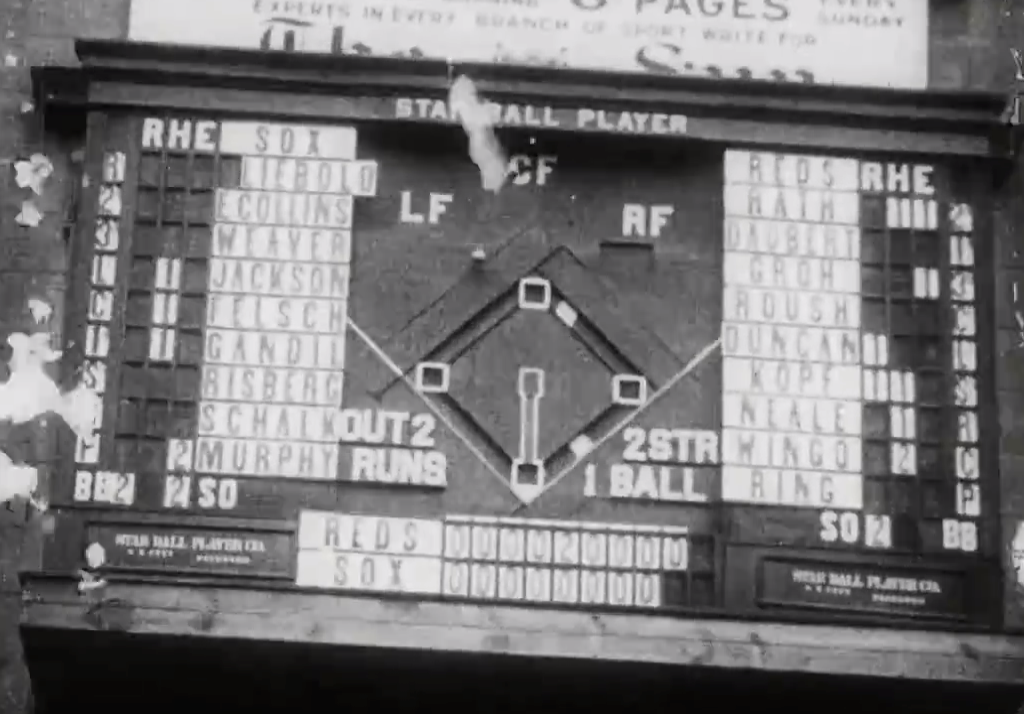
    1919 mechanical play -by-play scoreboard

    Back in 1978, a box of newsreels were found in the Yukon. Only recently though, was a newsreel of the infamous Black Sox 1919 World Series discovered in the collection.

    It’s a great find, and as Deadspin points out, it shows the infamous 5 run inning that made it obvious everyone that the White Sox were throwing the game. However that’s not what caught my eye. What I was astonished by was the mechanical scoreboard that allowed people in Cincinnati to watch the game in near-real-time. The board doesn’t just feature moving base runners, but also features a ball that moves around as the play progresses. I had never seen anything like this before. Even the Flash players that MLB.com puts out, don’t feature a moving ball.

    (more…)

  • Rachel Tyrell Gets a Job

    Categories: ,

    Premier Health Plans, a a health insurance broker, employs a rather elaborate chat bot to collect a customer’s basic information and interests before sending the potential customer to a real person to close the deal. It’s really a clever chat bot, but the odd thing about it is that it insists that it’s a real person. Clearly someone at Premier Health Plans, thought that a chat bot made good business sense, but at the same time didn’t think it was quite convincing, so they added in scripts to respond to questions like, “Are you a robot?”, with the idea that if they just deny it, that would placate enough curiosity and automaton-phobia to hold a potential customer on the line long enough to close.

    Think about this for a second. At some point there was a discussion that went something like:

    Analyst: In order to get n conversions per day, we need x telemarketers, which costs y dollars.
    Manager: Hmm, y is a lot of dollars, and that initial part of the conversation is where we lose most of customers. What can we do bring down this cost?
    Analyst: What if we used a robot?
    Manager: Not a phone tree. I hate those press-one-for-English type things.
    Analyst: No a really smart robot, like Siri.
    Manager: Yeah, a sexy robot, like Siri, but it would have to be smart. Can we make it smart?
    Analyst: That can be done, and it would only cost z dollars, which is much less than y dollars.
    Manager: Good. Good. Let’s do it.
    Analyst: I just thought of something. You know how people don’t like to leave voicemails, or deal with phone trees. What if they don’t like the robot?
    Manager: Well, we’ll just have robot lie.

    Sadly, the phone number and website, premierhealthagency.com are now disabled.