Photographer Jacob Sutton filmed snowboarder William Hughes wearing a suit covered in LEDs. By reducing the the aperture, the Sutton removes Hughes from the environment and forces the viewer to focus only on the movements of the rider.
-
The Transparency Grenade
Categories: tech
The Transparency Grenade by Julian Oliver is a “weapon” for radical transparency. A case modeld after a Soviet F1 hand grenade contains a gumstick linux computer with wifi and an integrated microphone. The gumstick packet sniffs the wireless network while simultaneously streaming the ambient audio to a remote server for analysis. (Essentially, the gumstick is running DriftNet or EtherPEG.) In an interview with We-Make-Money-Not-Art, Oliver says that he wanted to make the “information war” a bit more visual and iconic.
The Transparency Grenade was made for Weise 7, an artist collective in Berlin, and their Labor 8 exhibition. The exhibition features a the nexus of technology and surveillance.
-
From Our Vat to Your Table

Dr. Mark Post‘s lab at Maastricht University has created meat in a vat. The press is calling it “hamburger,” so I guess it is cloned bovine muscle. In a 2009 Wired interview, Post said that the problems facing in vitro meat is creating the texture. Taste is of little concern because, “The food industry is already expert at enhancing taste.”
-
Caffeine Zone 2
Categories: tech
Frank Ritter and Kuo-Chuan “Martin” Yeh professors in Penn State’s Applied Cognitive Science Lab, have developed a free iOS app Caffeine Zone 2 that tries to help you optimize your caffeine intake. The user enters his/her weight, and then notifies the app every time he/she consumes caffeine. The app estimates how much caffeine is in the user’s blood based what was consumed when, and the user’s mass. The app can warn the user if the amount of caffeine in the user’s system rises or falls below an optimal range, an notification can by pushed to the user. Additionally, the app can warn the user if his/her caffeine density is expected to impact the user’s sleep.
-
Areoshot
Areoshot is inhalable caffeine. For $2.99 you get 100 mg of caffeine (the same as a cup of coffee) and B vitamins, but divided into four doses. It was invented by a Harvard professor David Edwards, and it’s manufactured in a real factory, so I suspect that it’s safer than freebasing caffeine in your kitchen.
While novel caffeine delivery vectors have been around before, what I love about this is the moral panic that Chuck Schumer is trying to stir up about it. ZOMG! Someone may use it stay awake and drink alcohol! I take it that Chucky isn’t a fan of irish coffee then. There’s two things that bother me about Schumer’s comments. First it’s the alcohol, not the caffeine that’s the problem. Presumably Schumer wouldn’t have a problem with someone staying awake and doing something wholesome. Of course we can’t blame the alcohol here, because alcohol is all-American, this is just letting someone pervert its wholesomeness. The other thing about Schumer’s comment that bothers me is the undercurrent is the old puritan fear that someone is having fun, which is a bit ironic given that Schumer is Jewish. It reeks of the argument medical marijuana that it’s simply a canard, and that people getting the cards aren’t really sick, but rather are just people that want to get high. To which I say, So what? The argument makes pleasure naughty, as if that’s a bad thing. Contrary to the puritans, that’s simply not true.
-
Now You’re Playing with Gyroscopes!
Royal Caribbean’s Radiance of the Seas has a gyroscopically stabilized pool table.
That is pretty cool.
-
Drinking Water Running Through the Streets

Luzinterruptus is at again, this time putting glowing jars around water fountains throughout Madrid. Agua Potable Corriendo por las Calles (Drinking Water Running Through the Streets) is their protest to fact in last 30 years more than half of the public water fountains in Madrid have either been removed, disconnected, or allowed to fall into disrepair. 200 glass bottles were strung together and placed at four of the cities dilapidated water fountains in such a way to mimic water.
-
Kai Table
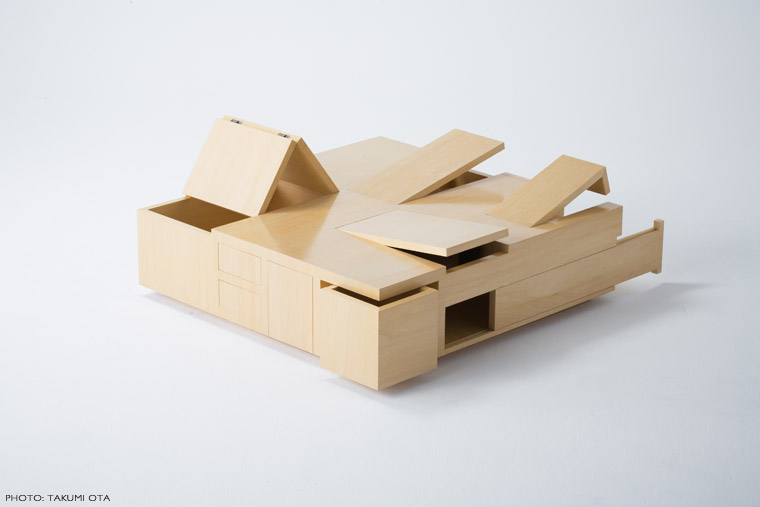
Designed by Naoki Hirakoso and Takamitsu Kitahara, the Kai Table has multiple internal compartments, but with the twist that each of them takes the form of a hidden compartment as seen on other furniture.
I’ve always been a sucker for hidden compartments, and although the location of the compartments are quite obvious given the size of the piece, it still presses all the right buttons for me.
-
Nitinol and Origami
Electronic Origami Flapping Crane w/ tutorial from Jie Qi on Vimeo.
Jie Qi at the High-Low Tech lab at MIT’s Media Lab, posted a HOWTO on nitinol and origami. In the HOWTO she mentions that you can’t solder the nitinol directly, and so you’ll have to have create a soldering pad for it. (She used a craft crimp bead.) Another tip she gives is the need to preheat the nitinol by running a 9 volt charge through it for five seconds. When the wire relaxes, it will become be longer than it was originally, and so you’ll need to retention the wire. Last of all, she warns against keeping the wire energized too long, lest your “burn out” the nitinol. In another project, Qi mentions she used 0.006 inch flexinol for the origami, but used 0.01 inch for the more rapid vine/snake project.
I have had a fairly long interest in synthetic plants and was thinking if nitinol could be used to in a heliostat or some sort of dinural deployable structure, but I never knew the reaction time of nitinol. Seeing it used understanding what voltages are required was helpful. (Poking around just now, I also ended up finding a handy nitinol wire width-voltage-time-force table.) While I doubt that I will ever actually build whatever vague idea idea I have for synthetic plant, I’ve come to conclusion that nitinol perhaps isn’t the best choice of materials if you want it to hold position for any considerable length of time (or at least not without some sort of mechanical latching).
