Category: tech
-
Kimono Lantern
Categories: tech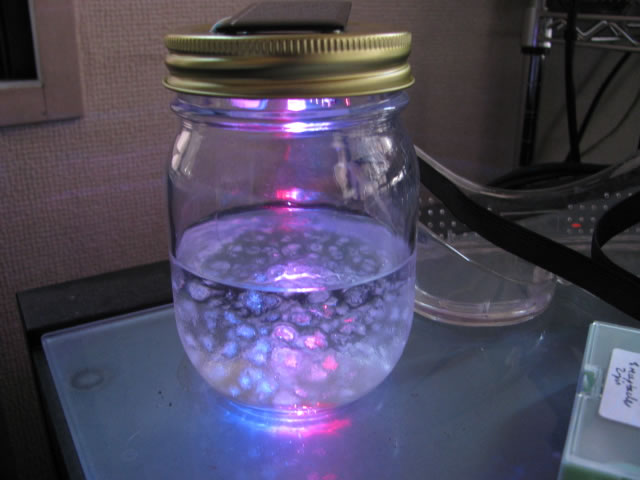
The folks at TokyoHackerSpace, have taken a break from building geiger counters, and built this rather cute table lamp. According to the write up, this solar powered automatic light was originally intended for tables at a local restaurant.
TokyoHakerSpace’s Kimono Lamp looks a lot like a DIY version of the €35 Marmaled / Jelly Lamp from Semiki, but more technically advanced. (The Marmaled uses a tilt switch and two AAA batteries.) Really, when it comes down to it, the Marmaled’s jar and black label is what sets it apart. Of course, you can always buy jars wholesale
Video of the Kimono Lamp in action after the jump.
-
It’s Over

Atlantis just landed at KSC, its permanent home. What can I say? The era is now over. The one honest spaceship is no more. I’m a pretty much in agreement with Miles O’Brien’s take. The space shuttle just never quite lived up to its potential. As O’Brien points out, the shuttle was designed with the one of its main ideas as building a space station, which it finally did some 17 years after its first launch.
I was looking at the list of canceled missions, and while most were simply got converted into unmanned launches, one did stick out to me: STS-144. The retrieval of the Hubble Space Telescope for display in the Smithsonian. Yes, it would have been a mawkish mission, but I still have loved to of had that happen.
So long shuttle.
-
Greg Mahlknecht’s Transoceanic Cables
Categories: tech -
Taking a Byte Out of Bandwidth Costs
Estimated Number of Internet Users 1.971E+11 Average Number of Objects on a Webpage 85 Average of HTTP Requests Made
When Loading a Webpage86 Average Number of Websites Visited
Per User Per Day94 Total Number of HTTP Requests Each Day 1.59336E+13 Estimated Cost to Transmit 1 Gigabyte $ 0.03 Total Dollars Phillip Hallam-Baker has
Personally Saved the World Each Day$ 445.18 -
So Long Shuttle…
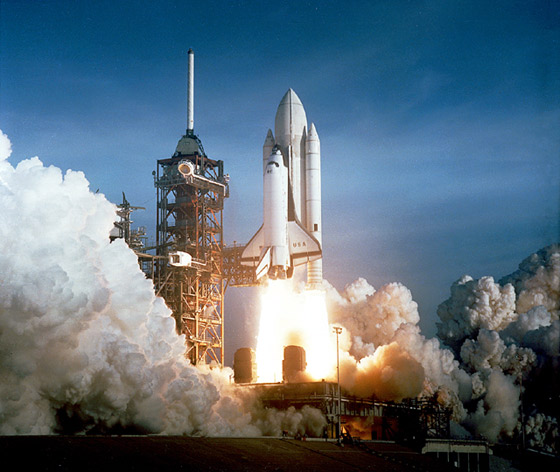
So today was the last shuttle mission. I remember my mom waking me up early that April morning and asking me if I wanted to watch real spaceship launch. Of course I did. We went into the living room, and sat in front of that old black and white television we had, and watched it live on channel 12. I may have had the first of my die cast space shuttles with me as we watched it. It was the coolest thing I had ever seen in my 5 year old life. I was a huge space geek then, and remained so up until sometime in high school I guess. We bought that day’s issue of the Southern Illinoisan, and I kept that folded yellowed displayed on my bedroom bookshelf for years. The front page had a large four color crew photo under the headline. That was unusual, as color printing wouldn’t become common for maybe ten more years. There was another story on the front page. It was about the latest developments in the Atlanta child murders.
Two days later, I watched the spacecraft that launched like rocket, land like an airplane.
Seven years later, after attending Space Camp, I witnessed the launch of STS-26, the first flight after the Challenger disaster. We were a few miles away, on shore of some inlet at Kennedy. My friend Billy got the passes by writing our congressman. We watched the launch through binoculars, and was looking directly over the top of the orbiter, just like on television. Over loud speakers, we heard the countdown, watched the boosters ignite, and then shuttle rise from its plume of steam and fire. Seconds later, we were hit with a wall of intense heat and noise. I didn’t expect that. We tracked the craft as it moved higher and further away until it disappeared behind a cloud. Behind the cloud, the SRBs separated, and the shuttle emerged, it was only barely pinpoint of light.
Then it rained. Apparently, a common, yet relatively unknown, but obvious, side effect of shuttle launches. Mix liquid hydrogen and liquid oxygen, and what do you get?
And now the shuttle is gone. Of course the shuttle was oversold. It never launched every week. It never carried enough payload. It tried to be all things to all people, and of course never completely satisfied anyone. Yet, it was an honest to god spaceship.
The designs for the shuttle replacement Orion / MPCVSpaceX’s Dragon, and Boeing / Bigelow’s CST-100 all are just capsules that seem like 1950s technology. While I don’t doubt they’re more practical, they seem disheartening. We’ve come a long way from the days of the “National Areospace Plane” (I always found it a bit weird that the artist depictions always made it look like Air Force One.)
-
Personalized Receipts

London based design studio Berg, teamed with Dentsu London to consider receipts as applications. From their description:
We’ve added semi-useful info-visualisation of the foods ordered based on “what the till knows†– sparklines, trends – and low-tech personalisation of information that might be useful to regulars. Customers can select events or news stories they are interested in by ticking a check box.
We think the humble receipt could be something like a paper “app†and be valuable in small and playful ways.
-
Otomata

Created by Batuhan Bozkurt, Otomata is a cellular automata music sequencer.
The sequencer consists of a two dimensional grid. Each row and column correspond to a musical note, with the first row and first column representing the same note, the and so forth. By clicking on cell, the user places a cursor at that location which travels in one of the four directions. When the cursor hits the end of the row or column, the associated musical note plays, and the cursor reverses direction. Cursors can also change direction if they collide with each other.I made two songs Otomata. The above pictured song is boring but symmetric. I like a later song I made more because it features a reoccurring motif while the cellular automata “improvises” over the top.
Otomata reminds me two other projects. The grid of moving squares reminds me of a Monome. I love the abstractness of the Monome interface, but I have no way to really justify purchasing one of these, but they look awesome.
The other thing Otomata recalls is Stephan Wolfram’s A New Kind of Music. (This “new kind of music” is apparently crappy 1980s MIDI, but I digress.) As you might have guessed, Stevie set his cellular automata rules up trigger MIDI events, giving equally predictable atrocious results.

