robotmonkeys

the monkeys know all

Category: tech

  • Geisha Tokyo’s AR Figure

    Categories:

    designboom writes about Geisha Tokyo’s AR figure. The AR figure consists of a large cube with different codes printed on the faces, along with a smaller cube that also has codes on the faces. When placed in front of a webcam, the figure is displayed, and the smaller cube can be used to interact with (read “accost and molest”) her. (Video after the jump.)

    The only time I’ve used this sort of AR was the last time I was at the LEGO store in San Jose. It’s kind of an odd experience, if you hold the box at the wrong angle, the image completely disappears; but I think the biggest thing is the lack of tactile feedback. Still, this kind of AR is something I find interesting, if for no other reason than novelty. Someday, in my copious free time, I’ll have to check out AR Toolkit and try my own AR project.

    (more…)

  • Watermarks

    Categories: , ,


    Last February Chris Bodle Watermarks Project was a series of projections throughout Bristol, England that illustrated high-tide water levels if the Greenland ice shelf would melt.

    I really like BLDGBLOG thoughts about this project. How idea of projecting a different geography over the current geography. A kind of public augmented reality.

    I would love for something like Watermarks to change people’s attitudes and motivate the radical changes that are needed, but it won’t. We’re doomed, by our own hubris.

  • Robot Gardeners

    Categories: ,

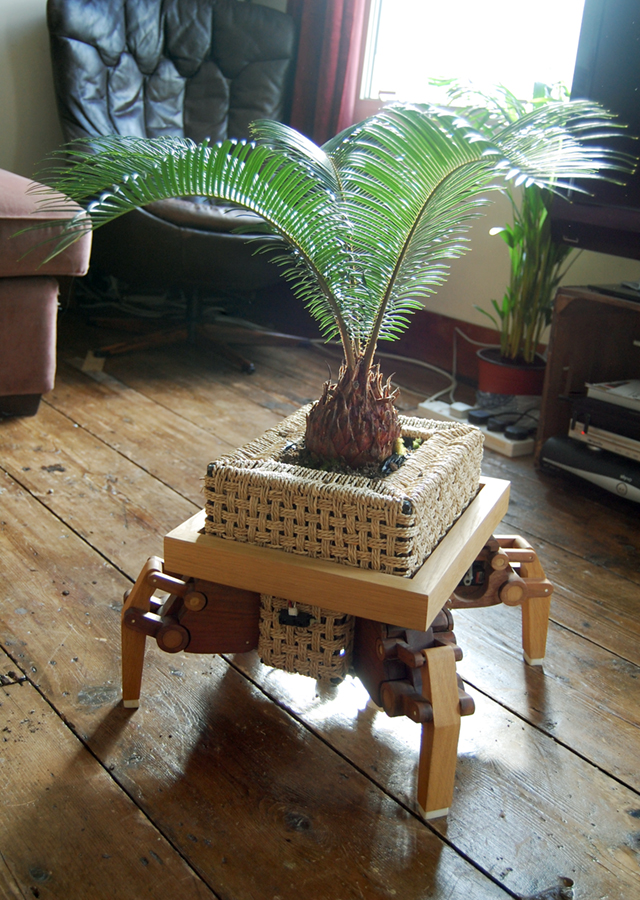
    The Play Coalition created Plantbot, a servo powered planter. The idea is that the planter continuously tracks the sun, ensuring that the plant get maximal sunlight.

    My initial impression was that this was a really cool idea, but when I started thinking about it, it seems like yet another one of those ideas that are utterly impractical. I mean, do you really want furniture that constantly moves? Well I guess a dog is kind of like that, but it doesn’t immediately back to the same place. In all honesty though, that’s an engineering problem. An accelerometer to detect pickup and not move for some time after being placed back down. I guess the other thing is having it move back to its original position each morning. Well, I guess that’s just a search pattern. So, I guess none of this is that big of a problem.

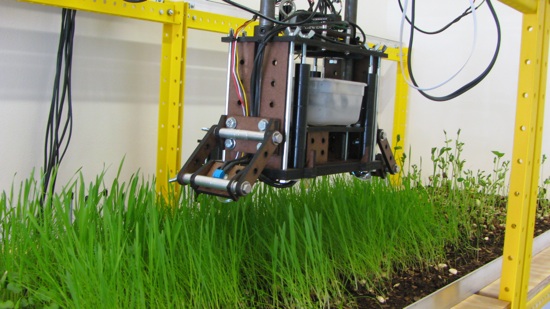
    Adafruit links to Peter Sand‘s Fast Planting. (Alas, the video is broken.) Fast Planting is a track mounted robot for tending an herb garden. The cursor moves across and grabs interchangeable tool heads to plant, water, and trim the plants. Completely over engineered. 😉

  • Diorama Weather Forecast

    Categories: ,

    analogweather

    Swiss Miss links to Kurt Riedi and Steffi Gloor’s weather site. Each forecast is presented as a photograph illustrating the qualitative weather for the day. Browse them all.

    I really like how endearing each photo is. Something like this would be infinitely better for my dad’s weather station (A Davis Vantage Pro. Highly recommended.), than the horrible UI that WView provides by default

  • God, I Love Festo

    Categories: ,

    Festo, a German robotics company, has unveiled yet another of their mesmerizing biologically inspired creations, AquaPenguin (Not to be confused with AirPenguin.) (Autoplay (bleh!) video after the jump.) You may remember Festo from their robotic jellyfish AirJelly and AquaJelly. (Videos of these also after the jump.)

    Festo creates these as part of their Bionic Learning Network. This project models natural animal systems in an effort to develop lightweight, and energy efficient designs for manipulators and locomotion. As a side effect of this research, Festo creates these robots in order to demonstrate the effectiveness of this approach.

    (more…)

  • March Tech Meetups

    Categories: ,

    Dorkbot SF is tonight at the Hat Factory (801 Minnesota St #08, SF)

    SHDH 31 is this Saturday (March 14) at the Rainbow Mansion (21677 Rainbow Drive, Cupertino).

  • Curiosity Cabinet

    Categories: ,

    curiosity_cabinet

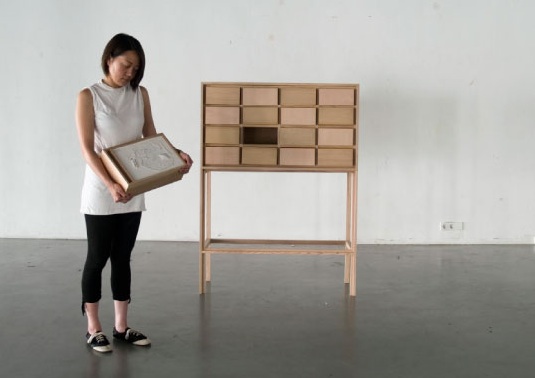
    Jon Stam has designed an RFID curiosity cabinet. The cabinet is lined on both sides with drawers and boxes. The drawers contain objects, while the boxes contain a USB memory stick and an RFID chip. Placing the box near an RFID reader, causes the digital content to be displayed.

    matandme has more photos info about this. DesignGuide.tv interview with Jon showing the cabinet off is after the jump.

    The thing that drew me to this cabinet was the clean lines of it. When I first saw this, I had no idea it was RFID enabled. I particularly like the pulls on the drawers, or more precisely the lack of them. Many times when there’s pull-less drawers, the outer panel is beveled for fingers to. In his design the pull is simply the main drawer face, with a second panel inset slightly inside to completely close of the drawer when it’s closed.

    One thing I don’t like about his design is that the digital curios are separate from the physical curios. I’m don’t think that distinction needs to be made. Digital objects don’t completely replace physical objects, (recordings, both audio and visual, excepted) but are complimenting them. For instance, when I traveled to Beijing, all my photos were digital, but those aren’t my only souvenirs. I have a Mao Book, a wad of cash, receipts, and tickets. It’s this collection, both physical and digital that commemorate my trip. It seems that a cabinet that attempts to recognize this dual nature of modern memories, should completely integrate them, rather than treat them as different things. If the each drawer contained the digital memories associated with the physical object contained in it, then this would be the case.

    (more…)

  • QR Graffiti for Pirate Radio

    Categories: ,

    Yuri Suzuki proposes using graffiti QR codes to promote pirate radio stations. Instead of broadcasting over the air, the audio is streamed directly to the phone whenever someone follows the QR code.

    I would think one of the joys of running a pirate station is the overt illegality of it. Granted the FCC doesn’t often go around shutting down even prominent stations. (Except of course, when they do), but simply streaming over the Internet is like setting up a blog that no one reads. (*cough* *cough*)

  • Unfinished Swan

    Categories: ,

    “Unfinished Swan” is an interactive project from Ian Dallas. The player exists in an all white world, which is slowly revealed as the player shoots black paint over the walls.

    Ian insists on calling this a “game”, but I don’t think that’s really a good word for something like this. Games have goals and rewards. This doesn’t. There’s no story, no goals, no explicit reward. It’s an experience, an interesting experience to be sure, but it’s a paradoxically a passive one.

    During his talk at TGS 2008 he says he’s surprised that “players” universally became bored within 20 seconds. The reason seems obvious, the lack of goals. I enjoyed watching the demo, but at the same time, I can’t imagine actually playing this for very long.

    It seems like he’s going for sublime enjoyment, sort of like Katamari Damacy, but he’s forgotten that Katamari had goals and rewards. Yes, Katamari was a very stylish and simple game, but it was fun because of the challenges. Without challenges there’s nothing to motivate the player, and so he/she quickly becomes bored. Since Unfinished Swan doesn’t have goals, it’s much more of an interactive video rather than a “game”. Not that that’s a bad thing per se, but they should not be confused. If Swan had a story, not even really challenges, I could see it working more as a game. Judging from the demo above, there’s potentially one there, but from his all too brief talk, I wonder if he’s trying to make it too open ended and free form.

    Thanks Paul.

  • Blinds + Light = Blight

    Categories: ,

    For Core77‘s 2009 Greener Gadgets competition, Vincent Gerkens of Belgium applied photovoltaics (similar to the ones seen before) to one side of venetian blinds and a electroluminescent foil to the other side to create Blight. During the day, it blocks light, but at night it releases it (so to speak).