robotmonkeys

the monkeys know all

Category: tech

  • Garden for a Not Too Distant Future

    Categories: , ,

    Spanish art collective, Luzinterruptus latest creation, Jardín para un Futuro, No Muy Lejano (Garden for a Not Too Distant Future), is 110 clear plastic containers, each containing a few leaves and branches, along with a green LED.

    The artist statement says that installation was a humorous statement about the lack of green space in modern cities; but given the frequency of their installations, I think that’s more just talk than anything.

    Luzinterruptus weekly installations are a bit repetitive. For instance, “Jardín” is reminiscent of their December work, Naturaleza Contra Cristal (Nature Against Glass), where they placed green LEDs and tree clippings on the Madrid Metro elevators stations. Parallels to Graffiti Research Lab‘s LED Throwies and Goggin and Keehn’s The Language of Birds could also be made.

    Yes, it’s repetitive. Yes, other people are doing the same thing, perhaps even better. But I’m a sucker for LEDs in the dark.

  • A Turing Machine

    Categories: ,

    Now this is inspired. Mike Davey has built an actual Turing Machine.

    A bit of background for non-CS people out there. A Turing Machine is a thought machine postulated by father of modern computing, and persecuted hero of World War II, Alan Turing. It was described as a machine that with a read-write head and infinite roll of tape that could pass back and forth under the head. Symbols could be read from the tape and then written back to the tape. What symbols, and where they were written would defined by rules that were triggered based on the symbols read from the tape.

    In modern parlance, this is a machine whose behavior is controlled not through hardwiring, but through software.

    Mike Davey isn’t the first person to build a Turing machine. (There’s at least one Lego Turing Machine.) But I do think he’s one of the few that built a machine that looks like a Turing Machine.

    Video after the jump.
    (more…)

  • LED Tables

    Categories: , ,


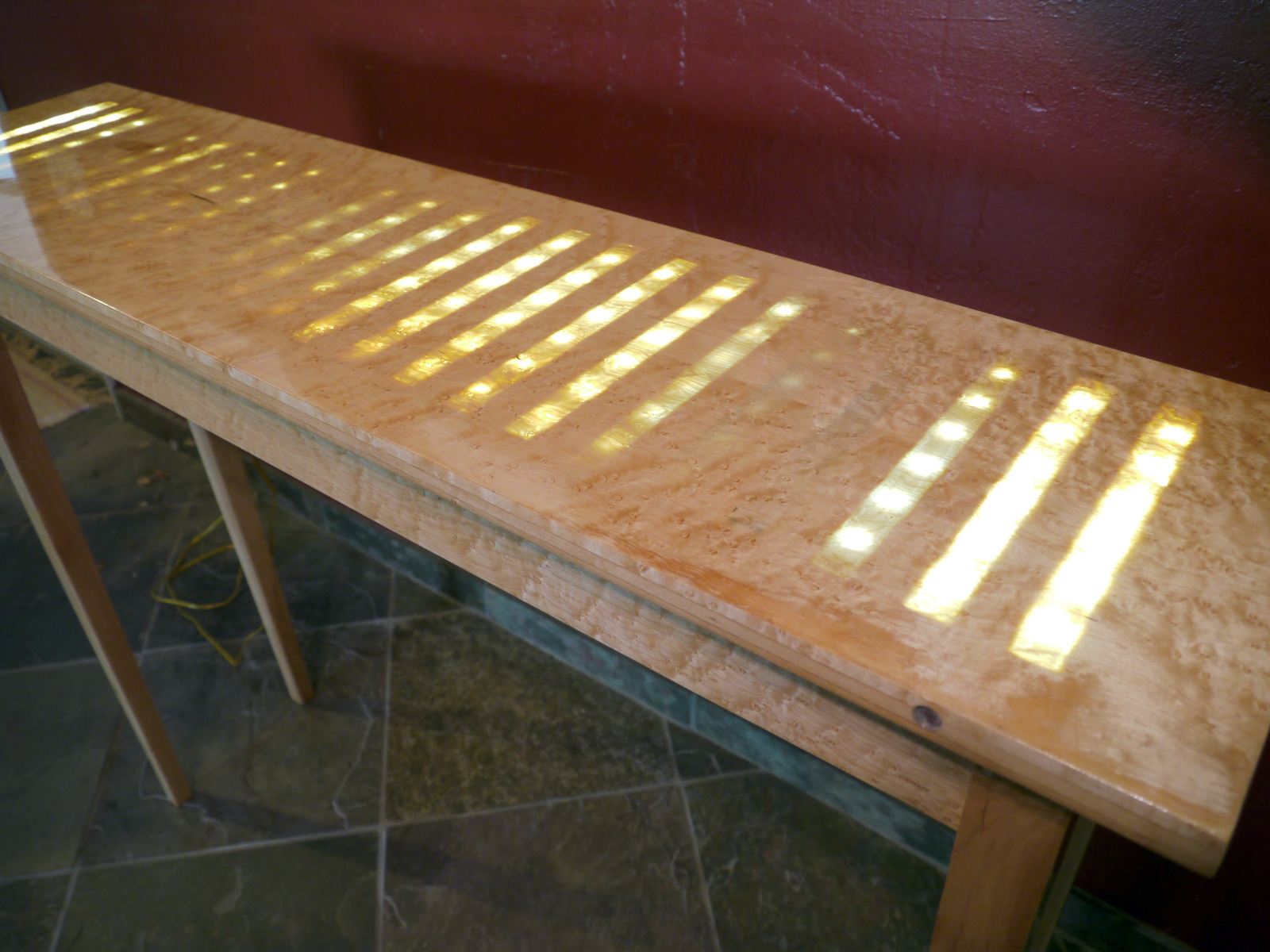
    Alex Schlegel‘s Day Table uses a photoresistor located in one corner, and eight ShiftBars (for a total of 24 channels) connected to an Arduino to play back the sunlight that fell on the table during the course of the day.

    Macetech built this table to demo their shiftbrite RGB LEDs and a Seeeduino. It’s a 9 x 9 grid, but since each LED has its own controller, the cost quickly climbs.


    While not a table, Dave Clausen‘s LED Cylinder is a good resource for discussing how to wire up set of addressable RGB LEDs, along with some good resources to parts and the like.

    Recently I’ve been thinking about a LED displays. Originally, I was thinking about a full 640 x 480 display, but after doing the math, that idea quickly shrank to a more manageable 32 x 24 display. While part of me thinks that having one of these tables would be interesting, I can’t help but think that in reality they’d just be ugly and too bright.

    I started to think about LED displays because my “coffee table” (It’s actually more an end table.) has a glass top and holes cut out in the back for electrical cables to pass through. What I really want is a multitouch display like either of these two guys are building. However, a multitouch is still pretty hacky and more DIY than I want right now. I like the idea of owning one of these tables, I just don’t want to build it.

  • La Vitrine’s LED Wall

    Categories: , , ,

    Lighting artists, the Moment Factory installed on the front wall of Montreal’s La Vitrine theater a full length interactive LED display. Made up of hellalot of RGB leds, the patterns react to people as they pass on the street.

    Moment Factory designed the lighting effects for Nine inch Nails‘s (w00t) 2008 Lights in the Sky tour. There’s a video of them talking about the effects on the tour, and how they were controlled from the stage rather than pre-scripted like stage effects normally are, but a combination of flash and their website being in flux have foiled me. Still, if you like effects and/or NIN, find the video. It’s not that long.

    Previously. Previously.

    Another video after the jump.

    (more…)

  • LED Eyelashes

    Categories: ,

    Soo-Mi Park‘s LED Eyelashes are just the thing the every fashionista at Tyrell corporate events, the Game Grid, and The Sprawl will be wearing.

    Echos of Diana Eng‘s (see also) Fairytale Fashion, only some how much less geeky.

    Video after the jump.

    (more…)

  • Recognizr

    Categories:

    The Astonishing Tribe (TAT), using software from Polar Rose, has created a mobile application that uses facial recognition to perform social search. Users submit photos of their faces to the Recognizr website, along with what web links they want associated with them (e.g. blogs, Flickr, or YouTube). Then by downloading an app to their mobile phone, they can take a photo of a stranger, submit it to the website, and if that stranger is a Recognizr user, find out all about him/her.

    This work reminds me of Bradley Rhodes‘s old wearable/AR emacs plugin, the Remembrance Agent. The idea behind that application was that, while wearing a PC-104 based Lizzy wearable computer, you’d type in names into emacs, and then bring up whatever notes you had about them. I don’t remember if it integrated with the Insidious Big Brother Database or not.

  • New Woo-Woos

    Categories: ,

    I’ll admit it. This post is just here to look at pictures of police cars. I kind of like police cars. I like the flashing lights. I like that they go fast. The first time I sat in a police car, I was maybe five years old. An Illinois State Police trooper, having lunch/dinner at the DuQuoin Pizza Hut, let me sit on his lap and turn the lights on. I remember leaning out of the car and expclaiming, “The Woo-woos! They WORK!,” and that he had a broken thumb. I imagined that he got shot in it. The last time I sat in a police car, it was getting a speeding ticket after I blew past another Illinois State Police car going about 90 on I-57. I sat in the front, because the back was full of cardboard boxes containing files. (I’m sure Andrew Tanenbaum would have something to say about that.) I noticed there was a lot of crap in a cop car. A laptop and two CB radios. (WTF?)

    Now with disclaimer out of the way…

    New police cars!

    Ford is eliminating the Crown Victoria police cruiser, and replacing it with the 2011 Taurus Police Interceptor (based on the 2010 Taurus). What makes this different from the Crown Vics? This one has unibody construction (which makes repairs more expensive), and 25% more fuel efficient V6 engines (263 HP and 365 HP available, with either front-wheel or all-wheel transmissions).

    Not to be left behind, GM is releasing a new 2011 Chevrolet Caprice Police Interceptor which comes in both a V8 (355 HP) and V6 FlexFuel (i.e. E85 or gasoline) engines.

    Dodge is staying with their Charger that released in 2006.

    However, the coolest police car out there is not the lame-o police Lamborghini, or the from-the-mind-of-a-seven-year-old-boy Caparo T1 Rapid Response Vehicle, but Carbon Motors purpose built (as opposed to a normal conversion) police car, the E7. It comes with night vision, a heads up display,an automatic license plate recognizer, voice control, and suicide doors! (More photos from Jalopnik.)

    Photos of all cars mentioned after the jump.
    (more…)

  • BarBot 2010

    Categories: , ,

    Next Wednesday and Thursday, (Feb 17-18), at the DNA Lounge (“A disorderly house injurious to the public welfare and morals”) (375 Eleventh St; SF) is BarBot 2010. Tickets are $10 advance, $15 day of show.

    Come out and have iZac pour you a fuzzy navel, and the girliest drink in the house!

    UPDATE: Tue Mar 16 05:23:28 PDT 2010
    Photos! Video!

  • The Splinter

    Categories: ,

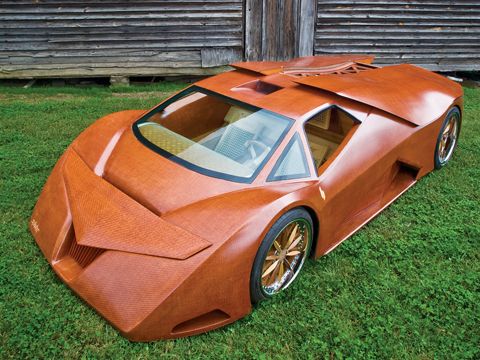
    NC State industrial design grad student, Joe Harmon is building a car by hand. Not just any car. A sports car that can reach 240 MPH. Not just any 700 HP, 240 MPH sports car. A 700 HP, 240 MPH sports car made almost entirely of wood. The body? Wood. The dash? Wood. The seats? Well, they’re wicker. The wheels? Oh, they’re wood too. The suspension? Yes, it’s wood too.

    Because he wants strength, but also a reduced weight (wood has a higher strength-to-weight ratio than steel or aluminum), he is creating the body out of custom made plywood that consists of layers of eighth inch wide cherry veneer strips that are then weaved together, and glued on top of a weaved birch veneer, a core of balsa wood, and then another woven layer of birch. The panels are then vacuumed formed into shape, using the same technique that’s used for carbon-fiber composites. All told, about 30 species of wood are used to make up the car.

    According to the last update, which was about a year ago, the outer shell was complete, but the internal components such as the V8 Cadillac Northstar engine and six speed Corvette transmission were yet to be installed. However, the car has drawn industrial sponsors like Delta/Porter-Cable, and has been making the rounds at different car shows.

    Thanks Dad!

  • Synthetic Plants

    Categories: , ,

    I’ve been thinking more about solar plants recently. I like how these projects combine both form and function. I’ve been thinking about what I’d like in one of these, and how one would be made. First, the power being collected by the solar cells needs to go somewhere. It could just feed back into the device, which is exactly what happens with plants, but part of me likes the idea of having the sculpture(?) have a practical use as well. If I want practicality, then USB ports for charging an iPod or a phone that I don’t have would be nice. At least one port, but four would be more than plenty. I’m leaning towards the solar cells charging some li-ion or nicad battery coupled with something like a Minty Boost.

    The second feature I’ve been hammering the previous electronic plants I’ve looked at is the movement, specifically heliotropism (i.e. sun tracking). It’s an interesting feature, and it would increase the power to the photovoltaics. I don’t like the idea of the hearing servos move, so that means nitinol wires, which also have the quality of more closely resembling natural motion by simply expanding and contracting. The next question then becomes, what form would the motion would take?

    If rigid photovoltaics are used, then panel could be mounted to a universal joint with the two outside corners independently controlled by nitinol. The other idea is to use flexible photovoltaics and hopefully no hinges and joints.

    Another interesting idea is to think about deployable structures, which would seem to imply the use of flexible photovoltaics. It’s not exactly the heliotropism I was thinking of, but it would be cool if the “leaves” opened up in the day, tracked the light, and then closed at night.

    Doing all of this nitinol might be kind of difficult. Heating nitinol causes it to contract in the 3 – 5 % range, doesn’t seem like much. This also means that for a deployable structure, it needs to collapse when the wires are extended,

    Will I actually build this? Probably not, but it is something I’ve been thinking about. Perhaps it would give me an excuse to visit Noisebridge.