robotmonkeys

the monkeys know all

Category: installation / sculpture

  • BarBot 2010

    Categories: , ,

    Next Wednesday and Thursday, (Feb 17-18), at the DNA Lounge (“A disorderly house injurious to the public welfare and morals”) (375 Eleventh St; SF) is BarBot 2010. Tickets are $10 advance, $15 day of show.

    Come out and have iZac pour you a fuzzy navel, and the girliest drink in the house!

    UPDATE: Tue Mar 16 05:23:28 PDT 2010
    Photos! Video!

  • The Splinter

    Categories: ,

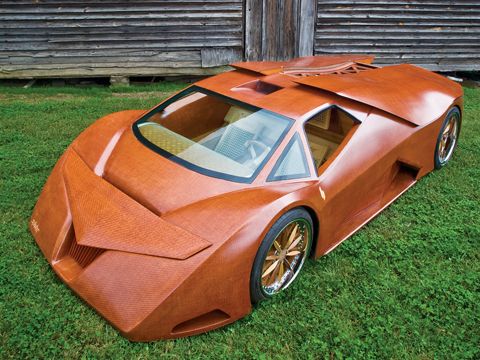
    NC State industrial design grad student, Joe Harmon is building a car by hand. Not just any car. A sports car that can reach 240 MPH. Not just any 700 HP, 240 MPH sports car. A 700 HP, 240 MPH sports car made almost entirely of wood. The body? Wood. The dash? Wood. The seats? Well, they’re wicker. The wheels? Oh, they’re wood too. The suspension? Yes, it’s wood too.

    Because he wants strength, but also a reduced weight (wood has a higher strength-to-weight ratio than steel or aluminum), he is creating the body out of custom made plywood that consists of layers of eighth inch wide cherry veneer strips that are then weaved together, and glued on top of a weaved birch veneer, a core of balsa wood, and then another woven layer of birch. The panels are then vacuumed formed into shape, using the same technique that’s used for carbon-fiber composites. All told, about 30 species of wood are used to make up the car.

    According to the last update, which was about a year ago, the outer shell was complete, but the internal components such as the V8 Cadillac Northstar engine and six speed Corvette transmission were yet to be installed. However, the car has drawn industrial sponsors like Delta/Porter-Cable, and has been making the rounds at different car shows.

    Thanks Dad!

  • Synthetic Plants

    Categories: , ,

    I’ve been thinking more about solar plants recently. I like how these projects combine both form and function. I’ve been thinking about what I’d like in one of these, and how one would be made. First, the power being collected by the solar cells needs to go somewhere. It could just feed back into the device, which is exactly what happens with plants, but part of me likes the idea of having the sculpture(?) have a practical use as well. If I want practicality, then USB ports for charging an iPod or a phone that I don’t have would be nice. At least one port, but four would be more than plenty. I’m leaning towards the solar cells charging some li-ion or nicad battery coupled with something like a Minty Boost.

    The second feature I’ve been hammering the previous electronic plants I’ve looked at is the movement, specifically heliotropism (i.e. sun tracking). It’s an interesting feature, and it would increase the power to the photovoltaics. I don’t like the idea of the hearing servos move, so that means nitinol wires, which also have the quality of more closely resembling natural motion by simply expanding and contracting. The next question then becomes, what form would the motion would take?

    If rigid photovoltaics are used, then panel could be mounted to a universal joint with the two outside corners independently controlled by nitinol. The other idea is to use flexible photovoltaics and hopefully no hinges and joints.

    Another interesting idea is to think about deployable structures, which would seem to imply the use of flexible photovoltaics. It’s not exactly the heliotropism I was thinking of, but it would be cool if the “leaves” opened up in the day, tracked the light, and then closed at night.

    Doing all of this nitinol might be kind of difficult. Heating nitinol causes it to contract in the 3 – 5 % range, doesn’t seem like much. This also means that for a deployable structure, it needs to collapse when the wires are extended,

    Will I actually build this? Probably not, but it is something I’ve been thinking about. Perhaps it would give me an excuse to visit Noisebridge.


  • Living Light

    Categories: , ,

    Taking a commission from Seoul’s City Gallery Project, The Living created Living Light, a vaguely forest-like structure that features a map of Seoul across the canopy. Each of the 27 panels in the canopy represents a particular neighborhood in the city. At night, each panel is illuminated based on air quality data as measured by various sensors throughout the city. Every 15 minutes, the panels turn on in the order of best quality to the worst.

  • Football Hero

    Categories: ,

    Make highlights Phil Clandillon and Steve Milbourne of Sony Music UK, latest project Football Hero. (Behind the scenes video after the jump.) Football Hero is a a copy of the open source clone of Guitar Hero, Frets on Fire, and series of pressure sensors. Soccer players kick balls against the sensors in time with the music.

    Yeah, it’s a viral video to promote Kasabian’s new single, but this is pretty cool.

    (more…)

  • DorkbotSF 47

    Categories: , ,

    Last night was DorkbotSF 47 at TCHO. There were three speakers, Timothy Childs, founder of TCHO, talking about how they quantify chocolate and make small testing labs for the Peruvian jungle; Michael Ang (aka Mang) showing off some of his work like Strange Attractor, artificial flowers to attract butterflies, and Blue Flower, yet another LED flower. The highlight of the evening though was Mark Pauline of SRL revealing his plans to build an 8 foot spine robot with a spike on the end. The evening was streamed, so definitely watch Mark’s critique of other spine robots that have been built. It’s around 51:00.

  • SRL Wants You!

    Categories: ,

    Survival Research Labs wants volunteers. They’re looking for pretty much anything.

    I saw an SRL performance at Zero1 back in 2006, “Ghostly Scenese of Infernal Desecration (Formally: Six Flags Over Hell).” It was very loud, and after the show, I dumbstruck. I remember walking back to the car thinking, “What the hell did I just see?” It was “interesting,” and I recommend it to anyone. (Video of the show after the jump.)

    If SRL wasn’t in Petaluma, I would totally join.

    (more…)

  • Score for a Hole in the Ground

    Categories:

    Jem Finer, of The Pogues and the Long Player fame, project Score for a Hole in the Ground is a large horn erected in the middle of Kingswood, near the village of Challock in Kent, England.

    Inspired by suikinkutsu, the input end of the horn is located in the middle of a large pit, that has been covered with a grate. As water falls into the pit, it strikes a series of metal pans. The sound from these pans is then amplified by the horn.

    Unlike The Long Player, I don’t find this work a pretentious waste of time, because it is a complete composition. It pretends to be nothing more than what it is. A large horn in the middle of the woods. Conversely The Long Player is just an algorithmic looping of all permutations of some seed while people stand about clucking their tongues about the impermanence of man and the universe. It is the hipster Long Now clock .

    I like the idea of walking through the woods, hearing some odd watery sound, following it to it’s source and being confronted with a rather large metallic horn jutting up from the soil. The visual incongruity of the unmistakably artificial blending in to the landscape reminds me of the Monolith from 2001.

    If I had even a not so large wooded area, I would want one of these.

    via Oddstrument

  • The Ultimate Luxury Good

    Categories:

    When I relaunched this, I kind of made a promise with myself that I would try to keep this to things I liked. “No rants,” I said; but somehow, I just can’t keep myself from sharing this.

    Seth Godin pointed out that the difference between a luxury good and a premium good, is that a luxury good was priced beyond its utility, while a premium good commands an above average price, because it provides above average utility. A luxury good is meant to be conspicuous consumption. We are supposed to long for the diamond encrusted iPhone, simply because it is expensive.

    With that in mind, I present you, Gläce Luxury Ice. Yes. Ice. Not even exotic ice, like dry ice, or anything. No. Just regular old frozen water.

    In addition to the unsurpassed quality and peace of mind, Gläce Luxury Ice allows differentiation for those consuming a premium drink from those with less discerning taste. Gläce Luxury Ice is a symbol of status for those accustomed to the very best. Simply put, Gläce Luxury Ice will help your drink taste better, and enhance your spirits the way they were intended.

    It also will may your dick look bigger for the paltry sum of $40 for 5 balls. That’s $8 per drink – for ice – one of the most ephemeral materials in the world. Good thing, it’s shown with a “premium drink” that I can get from my local BevMo! for $30.

    via Laughing Squid by way of eyebeam

  • Orkys

    Categories: ,

    Vivien Muller (previously) has created a new “plant,” Orkys. This one uses flexible photovoltaics as leaves to light what appears to be LEDs in in the flowers.

    I prefer his previous work, PhotonSynthese more though. Aesthetically, it’s more pleasing with the brushed metal stems and the blue leaves, instead of the all black stem and leaves. However, the more flexible materials in Orkys makes it easier to introduce nitnol wires in the leaves for sun tracking. Also, PhotonSynthese does something, while Orkys just sits there and looks pretty. There’s no reason why you can’t have something like this do both.