
Designed for Clarke Hopkins Clarke, John Leung designed “Magic Carp-pet“, a rug and table combination that uses lenticular printing to give the illusion of swimming fish viewers look at the table from various angles.
Video after the jump.
(more…)
the monkeys know all
Designed for Clarke Hopkins Clarke, John Leung designed “Magic Carp-pet“, a rug and table combination that uses lenticular printing to give the illusion of swimming fish viewers look at the table from various angles.
Video after the jump.
(more…)

The solar power and auto-on features of the Kimono Lantern reminded me pummpers and and SolarRobotic’s PumLantern, but much less spastic. (See video after the jump.)
The PumLantern’s case is clearly inspired by Japanese tatami lamps, but with stencils to break up the light. I recently saw another lamp that did something similar. I can’t say I approve of the choice of stencils, but I do like the idea of shapes covering the individual panels of the lamp.


Hanger One is being dismantled. Hanger One has been in danger of being torn down for years. It’s walls are contain PCBs. Save Hanger One, has been trying get NASA to reskin the hanger instead of tearing it down. NASA Ames now wants to use it for airship research. Federal funds were finally approved to reskin the hanger, until the House appropriations committee, on recommendation from the NASA Office of the Inspector General, eliminated the $32.8 million to replace the skin. This means PCB walls will be removed, and hanger will probably be torn down.
I say “probably,” because at the last minute the House changed the appropriations bill language to allow NASA to reapply for funds to reskin the hanger in the future. It is supposed to be painted with a sealant to protected it while NASA reapplies for funds.
Personally, I suspect it will be torn down in three years.
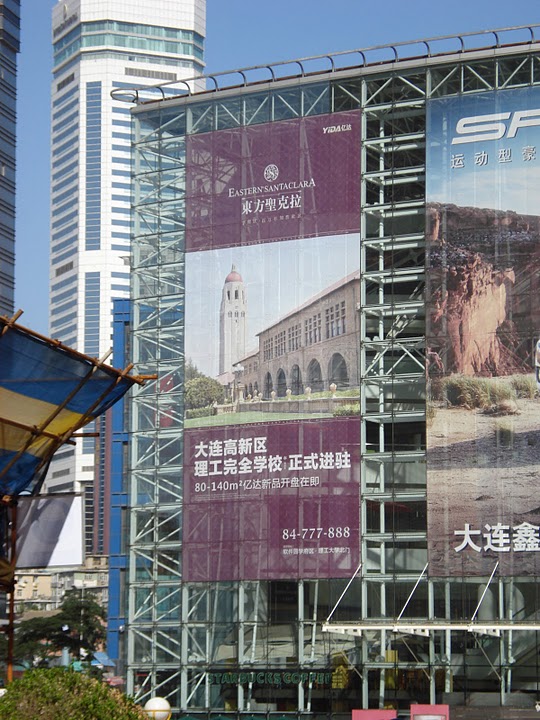
You may have heard of the Chinese knock off of Disneyland, or maybe you heard of the knockoff Hallstatt, Austria. Well,you can get a condo at Eastern Santa Clara in Dalian China. (Now with Stanford!)
Dalian has a software park on the edge of town where the city is trying to attract various high tech firms to locate offices. The newest housing developments in that area are named after cities in Silicon Valley. Eastern Santa Clara, and Eastern San Jose being the two newest.
The Eastern Santa Clara development is in partnership with Panasonic. According to Panasonic’s website, the condos are designed to be energy efficient with LED lighting and high efficiency home appliances. However, like all other housing in China, I suspect that the buildings are a series of poured concrete buildings with solid concrete walls. Which is a bit odd coming from an American perspective, and makes personalizing the units (e.g. hanging pictures) a quite a bit more complicated.
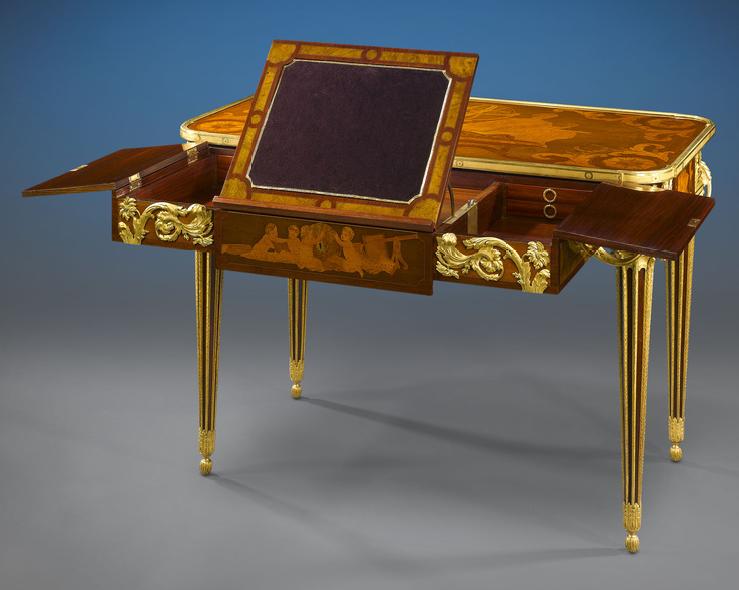
While reading about secretary desks, I came across a related type I had never heard of before, the mechanical desk. A fad of the 1700s, these desks featured mechanisms that hid shelves and surfaces when not in use. It’s a real shame that these didn’t make a comeback when computers became widespread. Computer desks were dreadful. While hiding a 21 inch CRT that weight 150 pounds wouldn’t have been easy, the idea hiding materials when they are not needed appeals to me.
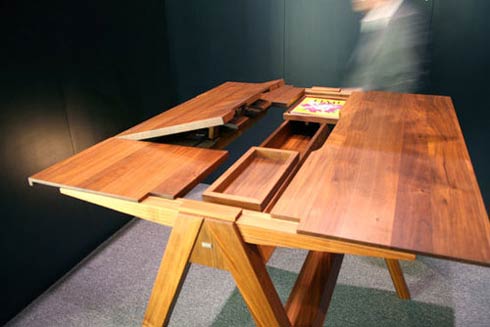
A modern interpretation of the mechanical desk is the Crescendo C2 from Stilvoll. I like how it looks like a drafting table, but expands to reveal bins. Of course, the role these bins play could have been solved with a traditional divided drawer. Still, this got me thinking.
I’ve considered getting a desktop computer, yet I don’t know what I would do with it. At work I love my MacPro and its three 24 inch LCDs, and part of me would love to have that setup at home, even if I don’t do much coding at home. If I ever took to telecommuting regularly, I’d need such a setup, including the Steelcase Leap chair, as even a 17 inch laptop just doesn’t quite cut it. Assuming I had desktop computer with multiple displays, I wouldn’t like having the monitors dominating the desk space. Yes, LCDs have a much smaller footprint than CRTs, but they still are visually imposing. Sometimes that’s what you want, but sometimes it’s not. A mechanical desk that could retract the screens would be great. Even better, if the desktop could expand. Perhaps a second pullout spring loaded leaf, kind of the like the Crescendo C2, but with a pushdown panel that has the screens mounted on swivel arms. Fold up the monitors and push them down into a little protected area behind the desk. Hide the tower and assorted wires in pedestal, and put file drawers in the other pedestal. (Personally, I prefer desks with legs rather than pedestals, but such a desk would look weird with big solid front on it.)
This is something I’m going to need to draw out.

Writing about traveling bookcases and other dead media storage solutions got me thinking about other furniture that always seems pregnant with possibilities, yet just isn’t practical anymore: secretary desks, and travel desks.
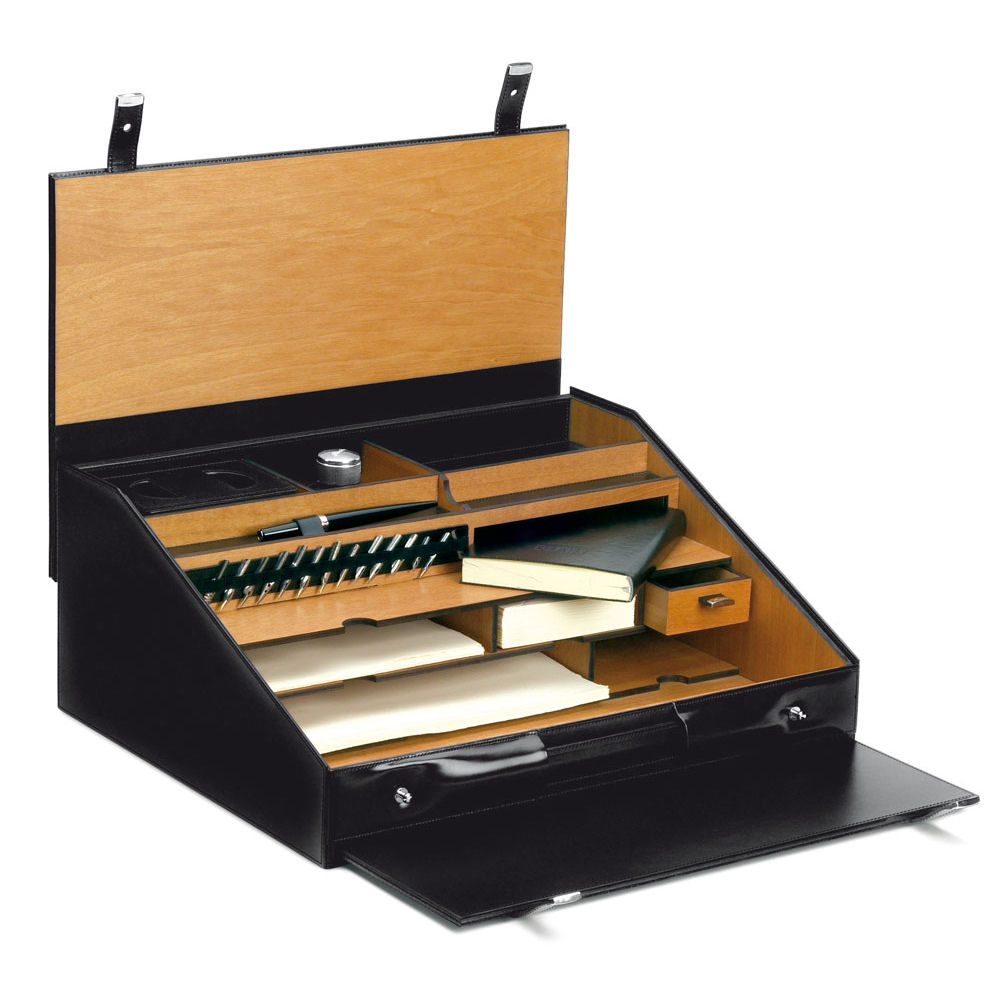
I love all the cubby holes in the secretary desks. Holes full of letters, bills, and checks. Drawers containing pens, ink wells, and seals. All of it lockable. Its very structure conveys, “Important stuff happens here.” Need to do serious work on the go? Get a travel desk, the attache case’s awkward cousin.
While tasks like answering correspondence and paying bills have remained, the form they have taken has changed. No longer are we physically shuffling atoms around, but rather simply information. Email, online banking, and all the rest has replaced paper. Similarly, we no longer need travel desks, as our laptop contains everything that the desk, could and much more. Add a network connection, and almost nothing is out of reach. It seems increasing clear that physical media is dying. Newspaper circulation is down. CD sales have fallen. DVD and bluray are now seen as a transition technology as streaming is becoming increasingly widespread. (Thus Netflix’s price hike.) With the advent of eReaders and tablet computers, even the books and magazines seems in danger.
We’re losing the need to deal with physical items, and as a side effect, it seems like we’re losing an ability to signal our tastes; which is ironic, given how personalization and sharing has taken over the web. When visiting someone’s home, we would occupy ourselves by perusing each other’s bookshelves. The books, CDs, and DVDs were essentially the tag clouds of the physical world. They weren’t there just for storage, but also to signal our personality. Our collections not only express how we see ourselves, but also how we want others to see us.

This huanghuali wood traveling bookcase (a “tushu shinggui” if you want to use Japanese)
sold recently for $47,000 at Christie’s. It’s picture had been bouncing around the blogosphere for a while, complete with comments about how beautiful it is. The stain really brings out the wood grain, and it look like the doors were cut from the same board. Which isn’t surprising, given that it dates from the early 1600s. It’s a very simple piece, with very little ornamental woodwork. The metal work is also very simple, but together they make a very elegant package. Unfortunately, there are no photos online of the box’s interior. Inside it contains two small drawers (for writing instruments?) and a single shelf.

When I first saw the bookcase, I immediately thought of another traveling bookcase, the USLHE traveling library. Both are similar in both form and function. (The tushu shinggui is undoubtedly better looking though.) The USLHE libraries were government owned crates of books that were issued on a rotating basis to lighthouses. Every so many weeks, when the lighthouse was resupplied, the libraries would be switched.
Both of these bookcases remind me of my media cabinet. Again, it’s the general shape. Of course my cabinet was designed to hold CDs and DVDs, not books, nor was it it meant to be particularly mobile. Still, they both store media compactly behind closed doors.

An unnamed lieutenant on the USS Voyager, is creating a Star Trek theme park in Jordan.
This is much cooler (or at least geekier) than Hamad’s totally not overcompensating exploits.

A 17 year old high school student survived the 220 foot jump with a broken tailbone and a torn lung.
He did it on a dare.
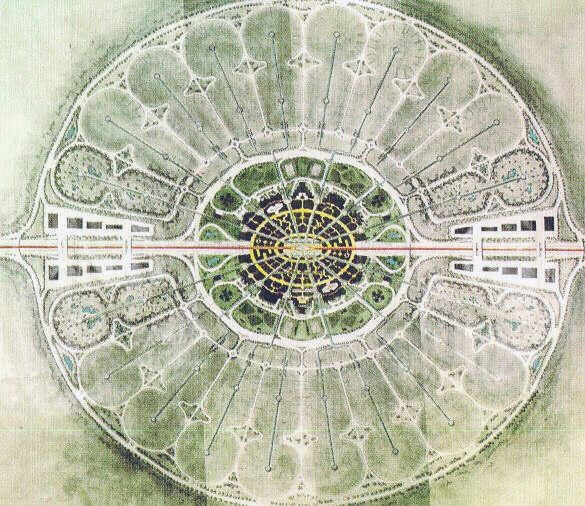
Calling Paul Romer’s charter cities, “OCP-like company towns” is unfair. The towns presumably would be run like any other city controlled by colonial power; or at least like any other city occupied by the colonial power (i.e the indigenous population kept out of the highest reaches of power). However there once was a plan for a real Delta City: Walt Disney’s EPCOT. A state of the art, centrally planned town, where every resident would be an employee of the Walt Disney Company (retirees would be evicted), and no one would own – nor control – their own residences. (See Walt Disney tout EPCOT at the 9:10 mark.) The town would be run by the board of directors of the Walt Disney corporation, presumably with Walt himself as feudal lord. Anti-democratic?, Well as the OCP President said in RoboCop 2, “Anybody can own a share [of OCP]. What could be more democratic?” (Funny how often rabid anti-communists aren’t exactly democracy’s biggest supporters, isn’t it?)
EPCOT never got off the ground, and instead turned into a rather dreary part of Walt Disney World with a giant golf ball for a center piece. Even when I saw it in 1989, it seemed like the fabulous future of 1992 circa 1982. (A robot that can draw pictures! A computer that plays music! Zounds!) The Experimental Prototype Community of Tomorrow didn’t completely die though. In 1996, it spawned Celebration, Florida, a town centrally planned by the Walt Disney Corporation.
Celebration, is planned according to the New Urbanism school. You may recognize this style from the town in the Truman Show, Seaside, Florida. Personally, I find the towns repugnant. The faux-small town feel, the “rustic” municipal architecture. It’s so saccharine. It’s Stepford, Connecticut. They leave me with impression zoning laws and homeowner associations that preoccupied with maintaining soul crushing conformity. Yet, I find the goals of walkable and picturesque towns enviable. It’s the idea of a master plan that bothers me, rather than towns simply being organic. I think this, but I ironically live in a country where pretty much every town was centrally planned to at least some extent.
It is obvious that Romer’s charter cities would be master planned communities, after all he posits that that new cities spring forth from undeveloped land relatively quickly. In order to do this, someone will have say what gets built and where. Unfortunately, whenever I think of new construction lots, I think “stifling.” Houses built every two feet, all with the same floor plan and different permutations of the same three architectural choices. (Do you want your door solid, or with an oval window? Dormers or no? White or cream? Rollaway basketball rim on the left or right side of driveway? No I’m sorry, nothing permanent can be attached to the front of the house. We must think of the property values you know!) Worst of all, since HOAs aren’t the government, you have no protections, no representation, and no benefits, all for the low price of $250 and three headaches a year.